TL;DR
- The Risk: Cutting print budgets during economic shifts often leads to "multichannel regret" and lost online revenue.
- The Renaissance: Global and Canadian giants like Amazon, Papa Johns and Walmart are doubling down on physical catalogs & direct mail marketing.
- The Data: Direct mail requires 21% less cognitive effort to process than digital ads [1].
- The Synergy: Integrating mail with digital can boost sales by 15% to 24% [2].
- The Solution: Use physical "nudges" to drive digital conversions and long-term brand memory.
When the economy tightens, marketing budgets are often the first to face the chopping block. For many businesses, direct mail is perceived as an easy expense to trim in favor of digital only strategies. However, history and data suggest that abandoning the mailbox is not a cost saving measure, it is a revenue risking one.
When a brand disappears from the physical world, it often disappears from the consumer's mind. This phenomenon, known as multichannel regret, has affected some of the world's most recognizable retailers. By examining their experiences, we can see why print remains a critical anchor for growth.
The Return of the Catalog: Lessons from Retail Giants
Several major brands have attempted to transition entirely to digital, only to find that their online performance suffered without the physical nudge of a mailer.
J. Crew and J.C. Penney
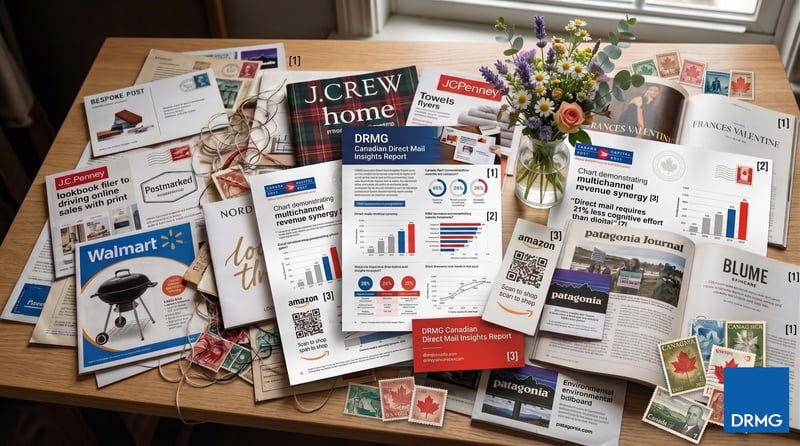
After a period of cutting back on physical mail, J. Crew returned to producing catalogs in 2023. The brand realized that the catalog served as more than just a product list, it was a storytelling tool that drove website traffic. Similarly, J.C. Penney brought back its mailing program after discovering that physical mailings were a primary driver of online sales [3]. Even in an era of digital dominance, the tactile nature of a look book provides a level of engagement that a scrolling feed cannot replicate.
The Amazon and Walmart Pivot
Perhaps the most telling endorsement of direct mail comes from the world's largest e-commerce entities. Amazon, despite being a digital first pioneer, now distributes a physical holiday toy catalog. Walmart has followed suit, launching multiple catalogs, including a 72 page toy shop guide and a dedicated home catalog. These companies understand that in home engagement is a powerful way to build excitement and secure a share of the household budget.
Canadian Home Services: Dominating Local Markets
The power of direct mail is perhaps most evident in the Canadian home services sector. For high ticket industries like roofing, HVAC, and windows, digital ads can be prohibitively expensive, with some Google keywords costing over $100 per click in Ontario [4].
One Canadian roofing company reported closing over $67,000 in contracts from a single campaign costing just $1,197 [4]. By targeting homes built between 1998 and 2005, they reached homeowners exactly when their roofs were entering the critical replacement window. This precision targeting, combined with the "Fridge Factor", the ability for a mailer to stay in the home for multiple days, creates a level of local trust that digital banners cannot match.
Canadian Innovation: Papa John’s Canada
Papa John’s Canada has also successfully used highly targeted direct mail to drive local growth [5]. By using household composition data, they customized imagery and offers for specific Canadian neighborhoods, timed around moments like "Back to School." This strategy demonstrates that direct mail is a precision tool for Canadian service and food brands to dominate local trade areas.
Nordstrom’s Tactile Reconnection
As of May 2026, Nordstrom has revived its print catalog strategy to move against the digital grain. By reintroducing physical mail traditions, including a 125 page anniversary catalog and 100 page holiday gift guides, the retailer is using tactile media to reconnect with customers in a way that digital platforms struggle to match [3].
Frances Valentine, Bespoke Post, and Patagonia
Direct to consumer brands like Bespoke Post and Blume have reported significant gains through direct mail experimentation. Bespoke Post noted that customers reached via print are significantly more likely to make a purchase, with higher average order values than digital only customers [3]. Similarly, Patagonia has evolved its strategy into the Patagonia Journal. This biannual publication moves beyond direct sales to offer immersive brand storytelling, providing a depth of engagement that offers more than a standard website.
Why Print Outperforms Digital Only Efforts
The shift back to print is not based on nostalgia, it is based on performance. The reason for this lies in the science of how we process information. Research indicates that physical marketing materials create stronger memory formation and a deeper emotional connection than digital equivalents [1]. When a consumer holds a piece of mail, they are more focused and less likely to be distracted by the constant notifications of a digital device.
Hard Data: The Performance Gap
Academic and industry research consistently highlights the synergy between print and digital. According to a study from the Harvard Business Review, catalogs paired with email campaigns generate 15% to 24% higher sales than email alone [2]. This halo effect proves that direct mail does not compete with digital, rather, it amplifies it.
Furthermore, the Canada Post Breaking Through report revealed that direct mail requires 21% less cognitive effort to process than digital media [1]. This means your message is not only seen but understood and remembered more effectively, allowing your brand to stick in the minds of Canadians long after they have put the mail down.
Cutting print might seem like a quick win for a budget spreadsheet, but the long term cost of lost visibility and decreased conversion is high. As retail giants and local leaders in the home service industry have discovered, the most effective way to drive digital growth is through the physical mailbox. If you are looking to scale your business with data backed strategies, it is time to reconsider the power of the original inbox.
Request a free geographic heat map of your target area at drmg.com.
About DRMG
Navigating the complexities of direct mail requires more than just a printer, it requires a strategic partner. With over 22 years of experience as a leader in Canadian direct mail, DRMG has helped over 18,000 companies grow their bottom line. As Canada Post’s largest shared mail partner, we provide unparalleled access to every Canadian household, ensuring your message reaches the right hands at the right time.
References
[1] Canada Post. (2024). Breaking Through: The Psychology of Direct Mail, pp. 7-14. https://www.canadapost-postescanada.ca/cpc/en/business/marketing/direct-mail/neuromarketing.page
[2] Zhang, J. Z. (2020). Why Catalogs Are Making a Comeback. Harvard Business Review. https://hbr.org/2020/02/why-catalogs-are-making-a-comeback
[3] Tolliver-Walker, H. (2026). When Cutting Print Backfires: Stories to Tell Your Customers. WhatTheyThink. https://whattheythink.com/articles/130222-when-cutting-print-backfires-stories-tell-your-customers/
[4] Industry Case Study: Direct Mail Performance for Ontario Home Services. (2026). Reported results via regional contractor performance data.
[5] Consumer Intelligence Group. (2025). Omnichannel Targeting and Activation: Papa John’s Canada Case Study. intelligentVIEW. https://consumerig.com/insights-blog/case-studies/success-story-6-increase-in-sales-for-papa-johns/
Comments