Every marketer knows the frustration of a technically perfect digital campaign that simply fails to move the needle. The design is modern, the offer is competitive, and the list is clean, yet the engagement is negligible. This often happens because the campaign is solving for a channel rather than for human psychology. Direct mail holds a natural, biological advantage. When a physical piece of mail lands on a doormat, a person must pick it up and hold it. This tactile moment creates a level of focused attention that a fleeting banner ad or an overflowing email inbox cannot replicate. To truly maximize this advantage, the message must be built around how the brain actually processes information and makes decisions.
TL;DR
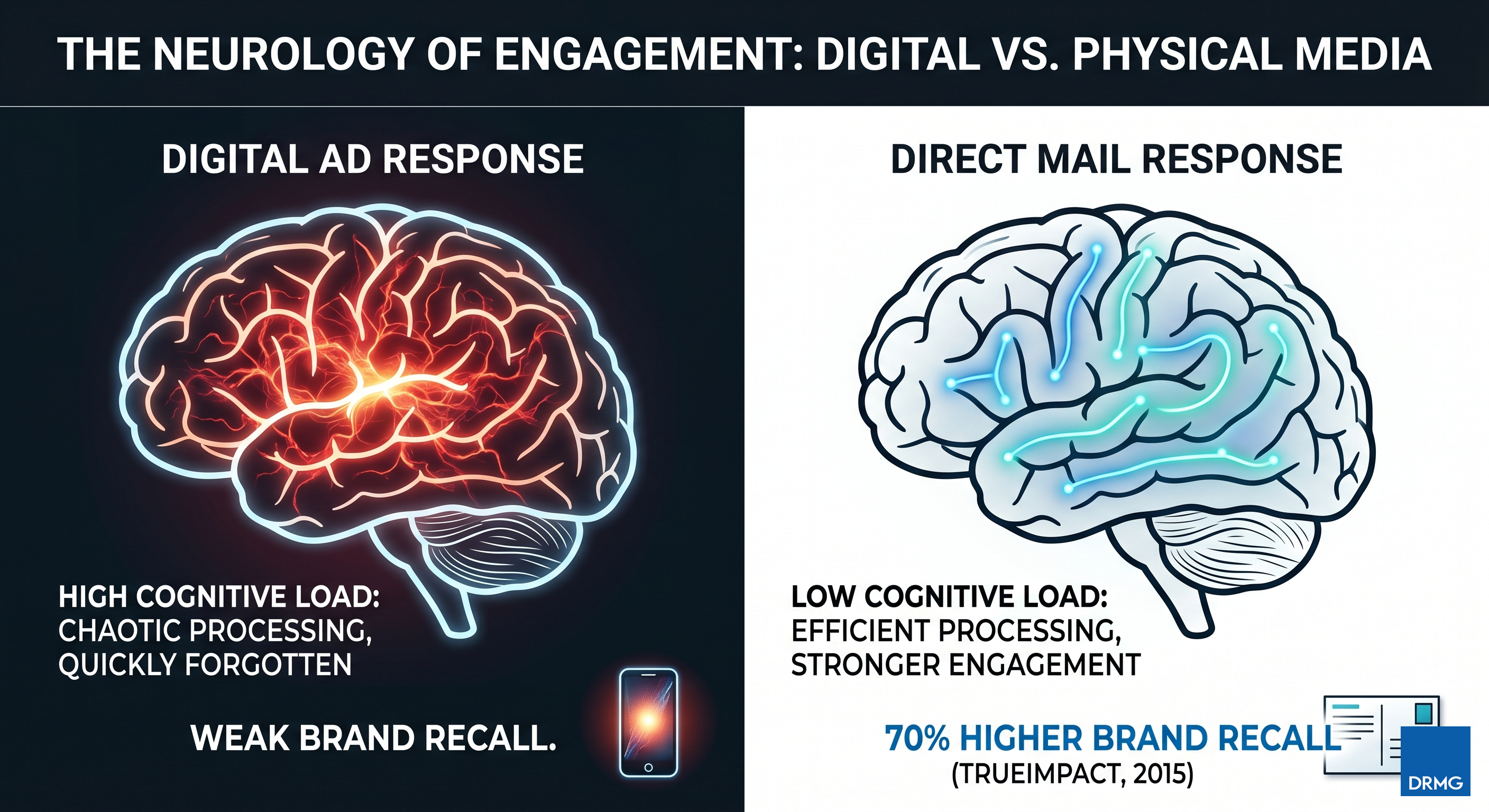
- Neurological Impact: Direct mail requires 21% less cognitive effort to process than digital ads, leading to 70% higher brand recall [4].
- Tactile Advantage: The physical act of holding mail triggers a stronger emotional and motivational response in the brain.
- Proven Triggers: Utilizing principles like Scarcity, Social Proof, and Reciprocity significantly increases conversion rates.
- Better ROI: Structured frameworks like SPIN and AIDA ensure your message earns attention rather than just demanding it.
The Neurological Advantage of Physical Media
When a consumer opens an email, they are typically in a triage mindset, deciding whether to click or delete in a fraction of a second. Physical mail slows this process down by engaging the somatic senses. Recent studies on consumer attention indicate that the average human attention span for digital content has dropped significantly, making the "dwell time" of physical mail a critical asset for brand depth [3]. According to the latest performance data, direct mail response rates average between 4.4% and 5% for cold lists, whereas email averages hover around 0.12% [2]. This gap exists because a physical mail piece forces a moment of tactile interaction that digital pings simply do not command.
The difference is deeply neurological. A landmark neuroscience study commissioned by Canada Post, conducted by TrueImpact Marketing, used EEG and eye tracking to compare media formats. The research found that direct mail requires 21% less cognitive effort to process than digital media [4]. Furthermore, it produces 70% higher brand recall and generates a 20% stronger motivation response. Because physical mail is easier for the brain to absorb, it is more likely to be remembered and more likely to prompt a purchase.
Foundational Elements of Influence
Before applying advanced psychological triggers, a campaign must master the basics of visual communication.
Strategic Design
Layout, typography, and color are not merely decorative elements, they are directional tools. They guide the eye before the brain consciously processes a single word. Contrast should be used to highlight the call to action, making the next step impossible to miss.
Meaningful Personalization
There is a significant difference between a mailer that simply includes a name and one that reflects the recipient’s interests. Current benchmarks show that personalized direct mail achieves an average response rate of 6.5%, compared to just 2% for generic versions [2]. This 3.25x performance multiplier demonstrates that utilizing purchase history or location data creates the genuine relevance required for high conversion.
Expertise in Execution
At DRMG, we have spent over 22 years as the leader of direct mail in Canada, serving as Canada Post’s largest shared mail partner to reach all Canadian households and helping over 18,000 companies grow. This experience allows us to provide the data and insights necessary to ensure your message resonates with its intended audience.
Applying Cialdini’s Principles to the Mailbox
Robert Cialdini is often referred to as the "Godfather of Influence." He is widely considered the leading authority on the science of persuasion and his framework of influence is particularly powerful in a physical format [1]. Here is how to apply these levers effectively:
1. Scarcity
Humans place higher value on items that are perceived as limited. Using firm expiry dates or "limited quantity" messaging creates a psychological nudge to act. The goal is to provide enough time for the recipient to respond without making the deadline feel so distant that it loses its urgency.
2. Social Proof
In moments of uncertainty, people look to the behavior of others. Including specific testimonials or data points, such as "9 out of 10 customers recommend us," reduces the perceived risk of a new purchase. For B2B campaigns, including industry accreditations or partner logos provides necessary third party credibility.
3. Authority
Consumers trust expertise. Direct mail allows space to demonstrate a track record through specific figures and certifications. Hard facts and verified data always outperform vague claims of being "the best," as authority triggers an automatic deferential response in the human brain [1].
4. Reciprocity
The human brain is wired to want to return a favor. In marketing, this is activated by providing value upfront. Whether it is a helpful guide, a high value coupon, or a free sample, giving something of value first earns the goodwill needed to ask for a sale later.
Structural Frameworks for High Conversion
Psychological triggers are most effective when housed within a proven communication structure. Two of the most reliable are SPIN and AIDA. Both SPIN and AIDA are communication frameworks designed to move a prospect from a state of neutrality to taking a specific action. While AIDA focuses on the emotional journey of the consumer, SPIN is a data driven method for uncovering deep-seated needs.
The SPIN Approach:
- Situation: Acknowledge the recipient’s current state.
- Problem: Identify a specific pain point they are likely experiencing.
- Impact: Explain the cost of not solving that problem.
- Need: Present your offer as the logical solution.
The AIDA Framework:
- Attention: Use a bold headline to stop the recipient from discarding the piece.
- Interest: Provide a fact or insight that makes the message relevant to their life.
- Desire: Connect the functional benefits of the product to an emotional outcome.
- Action: Provide a frictionless next step, such as a clear QR code or a dedicated phone line.
Direct mail is not just a delivery mechanism, it is a psychological tool. By combining the tactile nature of the medium with data driven influence strategies, brands can bypass digital fatigue and create lasting connections with their customers.
The most successful campaigns are those that respect the reader's time by being straightforward, hard hitting with facts, and easy to navigate. When you leverage deep industry experience and nationwide reach, your marketing moves from being a cost to being a high performing asset.
To put these psychological principles to work for your business, you need a partner who understands the Canadian landscape and the data behind every doorstep. Whether you are looking to build authority through professional mailers or drive immediate action with scarcity based offers, the team at DRMG has the expertise to turn neuroscience into measurable ROI.
Contact us today to start building a campaign that doesn't just land in the mailbox, but truly connects with the human brain.
References
[1] Cialdini, R. B. (1984). Influence: The Psychology of Persuasion.
[2] Association of National Advertisers (ANA). (2025). ANA Response Rate Report 2025/2026: Direct Mail Performance Metrics.
[3] Revenue Memo. (2026). Direct Mail Marketing Statistics for 2026: Personalization Performance Multipliers.
[4] TrueImpact Marketing. (2015). A Bias for Action: The Neuroscience Behind the Response-Driving Power of Direct Mail. Canada Post Corporation.

Comments