Every year, Canadian businesses waste thousands of dollars sending marketing materials at standard postage rates. If you are shipping flyers, catalogs, or promotional letters one by one, you are paying a premium for a process that should be automated. High growth companies scale their acquisition by leveraging commercial postal systems to drop large volumes of mail simultaneously for a fraction of the cost. Understanding the logistics behind high volume shipping is the first step toward reducing your cost per acquisition. When you know how the systems work, you can design smarter campaigns that predictably drive revenue.
TL:DR
- Pre-Sorted Savings: Bulk mailing unlocks deep commercial discounts by shifting the sorting and preparation work from Canada Post to an authorized mail partner.
- Volume Thresholds: To qualify for commercial rates, campaigns must meet minimum volume requirements, starting at just 100 pieces for machineable Personalized Mail.
- Turnkey Logistics: Leaving data cleansing, specialized bundling, and postal induction to an expert provider prevents costly compliance errors.
What is Bulk Mailing and How Does it Work?
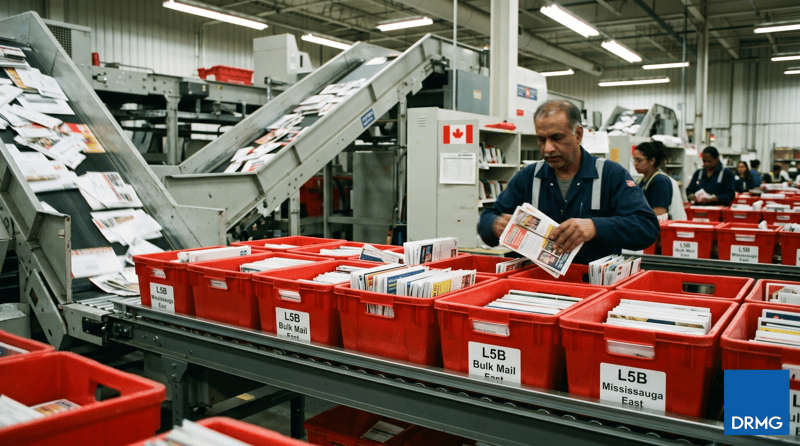
Bulk mailing is the process of preparing and entering a large volume of mail into the postal system simultaneously to secure discounted commercial postage rates. Canada Post offers these steep discounts because commercial mail partners take care of the heavy lifting. Instead of dropping unorganized boxes of letters at a local post office, a professional mail house cleans the data, groups the mail pieces by specific postal routes, stacks them in standardized trays, and delivers them directly to large processing facilities.
Because Canada Post skips the manual intake and initial sorting phases, they pass those operational savings directly back to the business.
While many marketers use the terms bulk mail and mass mail interchangeably, they represent two different approaches to distribution. Mass mailing is an umbrella term for sending a high volume of messaging, which can sometimes look like a generic blast. Bulk mailing refers specifically to the strict postal classification and structural preparation required to win those commercial discounts. You can send a highly personalized, data driven letter to a specific list of buyers and still have it classified as bulk mail, provided it meets the structural regulations of the postal service.
The Financial Advantage of Going Big
The primary driver behind bulk distribution is simple math, where the unit cost of your distribution shrinks as your volume scales. When you mail consistently in large quantities, you move away from standard retail stamps and enter commercial incentive programs.
According to research from the Association of National Advertisers, direct mail yields an average return on investment of 112 percent, outperforming many digital channels (1). When you pair that inherent return with lower commercial postage rates, your margins expand significantly. This scale creates a highly predictable channel for lead generation. By keeping a steady volume of physical touchpoints in the market, your brand avoids the volatile acquisition spikes common in purely digital advertising.
The Main Types of Commercial Mail in Canada
Most Canadian enterprises leverage two main categories of high volume mail to grow their market share.
1. Personalized Mail
This option is designed for targeted relationship building. It requires a minimum of 100 items for machineable mail or 1,000 items for special handling categories (2). It allows you to customize every single mail piece with specific customer names, past purchase histories, or unique promotional codes. It relies heavily on an accurate database to reach specific demographic profiles.
If you want to reach broad geographic areas without buying an external list of individual names, these options are ideal. Neighborhood Mail drops your promotional material into every single mailbox along a specific mail carrier route. Postal Code Targeting allows you to zoom in slightly closer, filtering specific postal codes based on shared demographic characteristics like average household income or homeownership status (3).
The Technical Requirements that Trip Up Small Businesses
Securing lower commercial rates is not as simple as showing up at a depot with a few thousand letters. Canada Post enforces strict regulations on how mail must be formatted, sorted, and bundled before it enters their facilities (4). If your campaign fails to meet these criteria, your entire batch can be rejected, or you may be forced to pay full standard retail prices.
- Address Accuracy Requirements: To qualify for commercial incentives, your mailing database must be validated against official postal data. This ensures you are not wasting money printing items for addresses that do not exist.
- Incentive Sorting and Bundling: Mail pieces must be grouped securely based on their destination sorting centers. They must face the same direction, be placed in authorized postal containers, and be accompanied by precise digital manifests.
- Physical Dimension Standardizations: The weight, thickness, and dimensions of each card or envelope must fall within strict millimeter parameters (4). Even a slightly non standard fold can cause a piece to jam in automated machines, instantly disqualifying it from discount categories.
Why Data Cleansing is Critical for ROI
Data degrades quickly because people move, families change addresses, and typos creep into customer databases. Before any commercial campaign launches, your list should run through a National Change of Address verification process. Cleaning your data prevents the costly mistake of printing and paying postage on duplicate items or undeliverable pieces. When every mail piece reaches an active, verified household, your response rates rise and your total cost per acquisition drops.
Streamlining Your Campaigns with an Expert Partner
Managing address updates, sorting constraints, and postal regulations on your own can easily drain your internal resources. That is why growing brands outsource the logistics to specialized teams.
Navigating these complex requirements is exactly where we excel. We handle everything from advanced demographic targeting and geographic sorting to final postal induction, ensuring your campaigns bypass compliance hurdles and deploy at the absolute lowest available rates.
When you leave the technical formatting to a team with decades of logistical experience, your internal marketing department can stay focused on what matters most, creating compelling offers that convert prospects into lifelong customers.
See how we can lower your cost per acquisition
References and Citations
(1) Association of National Advertisers Performance Metrics and Reports
(2) Canada Post Personalized Mail Direct Mail Overview
(3) Canada Post Smartmail Marketing Official Guidelines Document
(4) Canada Post Commercial Mail Technical Handbook
Comments