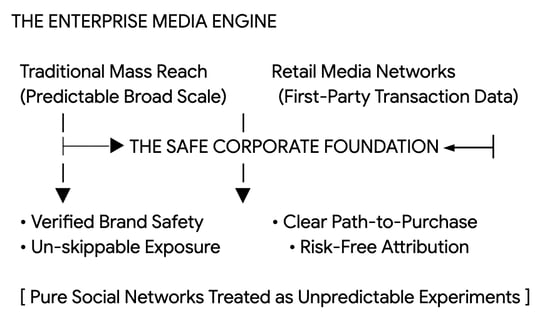
Corporate marketing departments are facing a structural identity crisis. For the past decade, the prevailing narrative dictated that traditional advertising was on its deathbed, and that agile, highly automated social media pipelines were the absolute future of customer acquisition. However, marketing landscape observers like Gary Vaynerchuk argue that the reality is far more nuanced. Rather than abandoning digital spaces, forward-thinking enterprise brands are adopting a "barbell strategy"—balancing extreme, high-impact digital and social creative on one end with premium, tangible, analog experiences on the other. This model highlights a significant trust gap in modern media. While multinational giants maintain a massive digital presence, they treat pure-play social media metrics with deep skepticism. To hedge against algorithmic instability and digital fatigue, the world's most successful corporations keep a massive portion of their foundational budgets anchored in physical channels, specifically within the expanding global direct mail advertising market.
TL;DR: The Corporate Media Realignment
- The Trust Gap: Legacy brands treat self-reported social media advertising metrics with extreme caution due to platform-controlled "walled gardens" and structural transparency issues.
- The Scale of Print: The global direct mail advertising market has expanded steadily, reaching a massive $65.96 billion market value as corporate giants rebalance their media mix (1).
- Superior Conversions: Physical media completely outpaces digital alternatives, boasting an average response rate of 4.4% compared to a meager 0.12% for standard email.
- Neurological Impact: Peer-reviewed neurological studies demonstrate that physical print media requires 21% less cognitive processing effort, cementing a 70% higher brand recall rate than digital ads (4).
- The Barbell Hedge: Corporate behemoths like Procter & Gamble and Nestlé meticulously police their digital exposure, routing content through secure agency ecosystems to insulate their legacy brands from online volatility (2).
The $65.96 Billion Heavyweight: Quantifying the Scale of Global Direct Mail
To appreciate why a balanced "barbell" media approach is gaining traction, one must step away from small-business marketing forums and analyze real enterprise spending data. The perception that physical print has vanished is completely debunked by the physical scale of corporate capital allocation. Data from global market research reports confirms that the direct mail advertising market scaled to a massive $64.8 billion valuation globally, and has grown steadily to $65.96 billion through multi-regional expansion (1).
This massive deployment of physical capital is led primarily by North American and Western European enterprise companies within the financial services, retail, and healthcare sectors (1). These multi-billion-dollar industries do not move budgets based on temporary internet trends; they move them based on audited, actuarial math. When an insurance or retail conglomerate distributes physical mailers, they are tapping into a predictable infrastructure that reaches consumers directly inside their homes, entirely bypassing the ad-blockers, spam folders, and crowded digital notification panels that render digital campaigns invisible.
Why Big Brands Distrust the Digital Ecosystem
The corporate shift to rebalance budgets with traditional media is born from a profound lack of trust in digital advertising infrastructure. When enterprise companies buy ads on platforms like Meta, TikTok, or Google, they are operating within "walled gardens." These tech giants act as the publisher, the ad network, and the auditor, effectively measuring their own homework. This lack of independent, transparent measurement has created an atmosphere of deep skepticism among Chief Marketing Officers (CMOs).
The Tracking Collapse and Revenue Loss
For years, social media networks justified their premium ad pricing by promising hyper-targeted behavioral tracking. The systemic phase-out of third-party tracking mechanisms has completely shattered this value proposition. Large-scale field experiments published in the Proceedings of the National Academy of Sciences (PNAS) by Gu, Johnson, and Kobayashi proved that eliminating third-party tracking cookies slashes publisher advertising revenue by 29.1% (2).
Without these tracking cookies, social media platforms cannot accurately verify if an ad was viewed by a real consumer or a malicious automated bot network. Enterprise companies with multi-million dollar budgets cannot tolerate this level of financial leakage. Physical print media offers a complete antidote to this tracking degradation, providing an audited distribution model that maps precisely to verified physical addresses.
The Attention-Measurement Paradox
Despite the massive narrative hype surrounding digital media, social networks present unique challenges when it comes to holding consumer focus. Academic investigations published in the Journal of Advertising by Bruns, Kopka, Borgmann, Prior, and Langner utilized mobile eye-tracking and viewport logging to validate advanced attention-measurement methods (3). The research highlights a critical reality in the digital ecosystem: because online user habits are driven by fast-paced "infinite-scroll" mechanics, digital promotions must overcome massive visual noise just to achieve baseline consumer eye-fixation and brand recall (3).
Users have conditioned themselves to glance past digital ads in a fraction of a second. This reality forces big brands to diversify their outreach via tangible alternatives, utilizing comprehensive strategies like coordinated direct mail marketing programs to command real, undivided consumer attention at home.
The Neuro-Science of Touch: Why Traditional Media Converts Higher
The superior performance of physical mail over digital alternatives is deeply rooted in human biology and cognitive processing. When a consumer interacts with an ad on a smartphone screen, their brain is simultaneously managing a barrage of competing micro-stimuli: push notifications, text messages, and app alerts.
Reduced Cognitive Load and Enhanced Recall
A landmark biometric study conducted by Canada Post and TrueImpact confirms that navigating physical print advertisements requires 21% less cognitive processing effort than decoding an identical message displayed on a digital screen (4).
Because physical media minimizes brain fatigue, consumers can absorb complex offers with significantly less friction. This cognitive ease translates directly into long-term mental retention, with direct mail yielding a 70% higher brand recall rate than short-lived digital impressions (4). Physical media creates a durable sensory imprint that lingers in the household, outlasting a digital scroll that vanishes from a consumer’s mind in a matter of seconds.
The Pure Response Rate Discrepancy
When we look at raw conversion data, the contrast between physical media and digital alternatives becomes even more dramatic. Large-scale tracking data compiled in the ANA/DMA Response Rate Report shows that direct mail campaigns achieve a remarkably strong 4.4% average response rate. When placed side-by-side with email marketing, which crawls at a global average response rate of just 0.12%, the physical mailbox outperforms the digital inbox by an order of magnitude.
Furthermore, official consumer insights published in Canada Post's "Generation Gap" report show that direct mail remains a highly valued, trusted, and deeply engaging marketing tool for younger audiences, defying the misconception that younger demographics are exclusively responsive to digital avenues. This trust premium explains why premium brands are scaling back single-channel digital ad spend, opting instead to reach customers using targeted shared media marketing strategies that blend physical authority with modern data analytics.
Behind Closed Boardroom Doors: P&G and Nestlé Financial Blueprints
To see this defensive marketing strategy in action, one only needs to look at the financial behavior of consumer product giants like Procter & Gamble and Nestlé. These firms operate on immense economies of scale, meaning even a small misallocation of ad spend can result in millions of dollars in wasted capital.
Procter & Gamble's Risk Mitigation Plan
Procter & Gamble, historically one of the world's most prolific advertisers, views the unmoderated digital ecosystem with immense caution. To protect its massive household portfolio (brands like Tide, Dawn, and Pampers), P&G keeps its foundational mass-reach capital anchored in legacy broadcasting and traditional physical print networks.
While the company heavily utilizes digital video media to support its retail footprints, brand leadership strictly limits pure-play organic social exposure. To hedge against algorithmic shifts, audience fragmentation, and volatile automated ad pricing, P&G ensures the vast majority of its core brand equity assets remain insulated within highly secure, predictable, and fully audited traditional media channels.
Nestlé's Search for Creative Quality
Food and beverage conglomerate Nestlé manages its marketing through an aggressive lens of brand safety. Because automated social media ad networks frequently place corporate ads alongside unpredictable or brand-damaging user content, Nestlé enforces rigid structural control over how its digital assets are developed.
According to global disclosures from Nestlé Global CMO Aude Gandon, the company partners closely with established holding agencies like WPP and Publicis to film all marketing assets across 41 dedicated content studios located around the world. By centralizing production in these verified studios rather than crowdsourcing unvetted digital content, Nestlé halves its production costs while completely shielding its century-old corporate reputation from the quality control issues plaguing unmoderated social platforms. Furthermore, they actively leverage co-operative print media publications to secure a safe, physical, and brand-vetted consumer environment.
The Strategic Shift to Retail Media Networks
As Fortune 500 conglomerates actively manage their exposure to standard social media platforms, they are reallocating those digital ad dollars into alternative, high-security transaction spaces known as Retail Media Networks (RMNs). Owned directly by major retailers like Walmart Connect, Target Roundel, and Amazon Advertising, these networks offer enterprise brands something that social networks cannot provide: verified, first-party purchasing data locked within a completely brand-safe environment.
According to global media reports published by Dentsu, Retail Media has surged as the fastest-growing digital marketing channel, expanding at a rapid 14.1% annual growth rate. Big brands love these networks because they form a closed-loop ecosystem. A social media platform can only report an unverified "impression" or "view," but a retail media network can track a consumer directly from the digital screen straight to a physical barcode scan at a local register. It provides complete financial transparency, removing the assumptions and fraud risks that continue to plague standard social platforms.
Embracing the Multi-Channel Strategy
Vaynerchuk's balanced "barbell" framework serves as a critical wakeup call for modern businesses. While social media platforms remain popular tools for capturing passing cultural trends, they do not possess the structural stability, data transparency, or deep consumer trust required to anchor a sustainable enterprise marketing strategy on their own.
The world's most successful corporations realize that the most profitable path forward does not involve choosing between print or digital; it requires a unified approach. By anchoring a brand's baseline identity in highly trusted, physically permanent mediums like direct mail, companies can create a bulletproof foundation of consumer trust. Once that physical connection is established, digital channels can be used as lightweight tools to support the campaign, protecting the company from algorithmic shifts and digital ad fraud while maximizing long-term marketing ROI.
Is Your Current Ad Spend Working For or Against You?
Don't let unstable digital algorithms dictate your business growth. Whether you are looking to build a high-converting multi-channel strategy or want our data analysts to ruthlessly evaluate your current marketing spend to find hidden waste, the DRMG team is ready to deliver audited, bottom-line results.
Get in touch with a DRMG Specialist today to build your next high-performance campaign.
About DRMG (Direct Response Media Group)
As Canada’s leading direct mail advertising experts, DRMG helps businesses bridge the gap between high-impact physical marketing and measurable digital ROI. Delivering millions of highly targeted shared and solo print products across the nation annually, we specialize in transforming customer data into physical conversion engines. From hyper-local retail footprints to nation-wide corporate distribution, our data-driven print programs are optimized to put your brand in front of the right household, every single time.
References
- (1) The Business Research Company. (2026). Direct Mail Advertising Market Report 2026. Global Market Analysis and Forecasts. https://www.thebusinessresearchcompany.com/report/direct-mail-advertising-global-market-report
- (2) Gu, Z., Johnson, N., & Kobayashi, M. (2026). Can privacy technologies replace cookies? Ad revenue in a field experiment. Proceedings of the National Academy of Sciences (PNAS), 123(19), e2603752123. https://www.pnas.org/doi/abs/10.1073/pnas.2603752123
- (3) Bruns, D., Kopka, C., Borgmann, M., Prior, M., & Langner, T. (2025). Measuring Gaining and Holding Attention to Social Media Ads with Viewport Logging: A Validation Study Using Mobile Eye-Tracking. Journal of Advertising, 54(5), 655-672. https://www.tandfonline.com/doi/pdf/10.1080/00913367.2025.2524186
- (4) Canada Post & TrueImpact. (2015). A Bias for Action: The Neuroscience Behind Effective Direct Mail. Office of the CMO Study. https://www.canadapost-postescanada.ca/cpc/doc/en/blogs/CPC_Neuroscience_EN_150717.pdf
- (5) Canada Post. (2017). Generation Gap: Navigating Generational Conversations. Consumer Insights Research E-Book. https://www.canadapost-postescanada.ca/cpo/mc/assets/pdf/business/generation_gap_en.pdf

Comments